
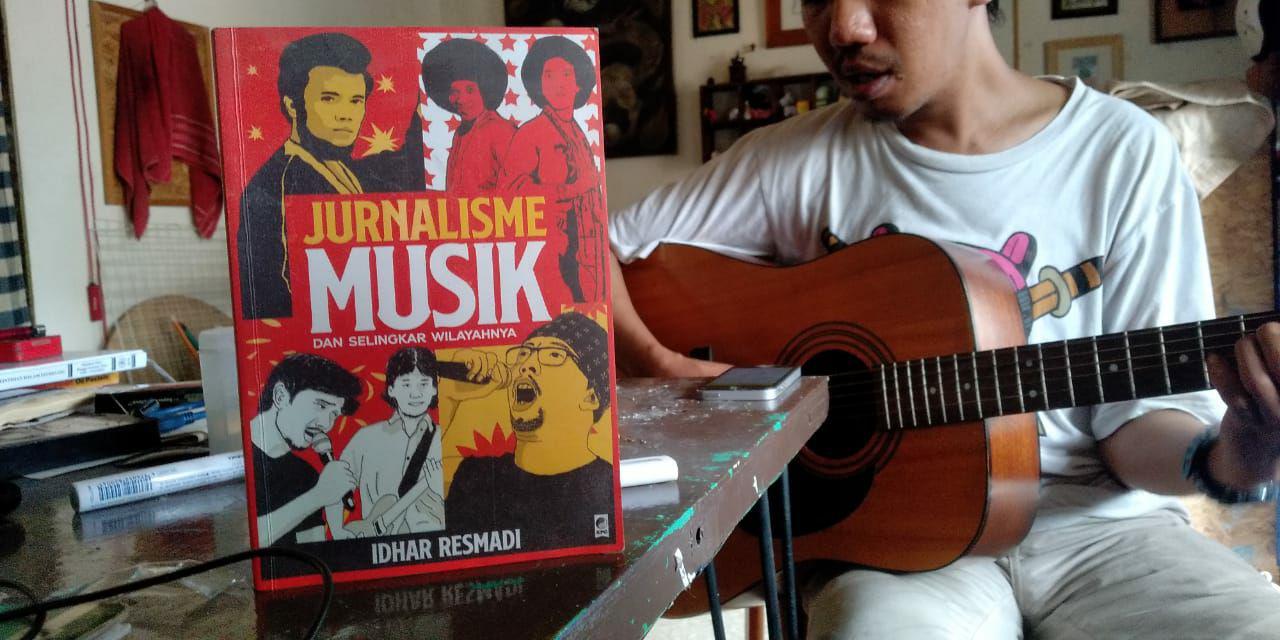
Music is a branch of art that has a unique position in humans. So, it is naturally discussed a lot apart from being listened to. If we then talk in the context of literary discussions, then music is written a lot. The writing can be in the form of music criticism, academic studies, or journalism products.
However, is it true that music has been discussed comprehensively in the literary realm? Especially in Indonesia? Music writer Idhar Resmadi tries to explain this in his book entitled Jurnalisme Musik dan Selingkar Wilayahnya (Music Journalism and Its Surrounding Area)
Three words would be appropriate to describe this book: intelligent, complete, and comprehensive. This book is brilliant because it can capture and explain everything about music journalism from its birth in the West (read: America) in the 1960s to how it entered Indonesia. Not only matters of journalism but all other ins and outs of writing about music are also discussed: music criticism, the commodification of music, and how journalism and music criticism were initially born as an extension of the music industry.
This book is complete because of the long history of music journalism over several decades and music criticism over several centuries, which could be explained in only 198 pages. All models of journalism, from sophisticated and adhering to 5W1H standards, literary journalism to naughty gonzo journalism, are also presented.
This book is comprehensive because it has reference sources that are not jokes. Each statement is a valid fact whose reference source can be traced. It must be admitted that one of Idhar’s advantages is that he has complete archives—the same as the late Denny Sakrie. Literature, interview results, and artifacts of musical events are truly fitting complements.
Interesting Ideas
Of course, interesting ideas will emerge in this book. One of the exciting things was when Idhar discussed technical matters of music writing/journalism. The question arises: What is the most appropriate form of musical writing?
In one hand, some think that music writing must be rich in theory, data, facts, and trivia about music to disseminate knowledge. In the other hand, music writing is considered a journalistic product that should make readers comfortable. So, simplification and parsimony are needed so that the message contained in the report is easy for readers to understand. The rigors of music theory and other musical techniques must be trimmed in the context of this simplification.
Idhar tried to position himself neutrally in the middle. “The ability of a good music writer, for me, is precisely when they are like a good public intellectual: able to simplify complicated things. “A good music journalist is when he can convey his message to readers,” said Idhar.
This could become an interesting discussion: Do music journalists have to be familiar with musical techniques and then obliged to present technical matters in writing, which is then read by an audience unfamiliar with technical issues? Or, instead of explaining complicated musical technical subjects, should music journalists simplify their presentations with various analogies, metaphors, and other language styles?
For example, to describe the song “Weird Fishes/Arpeggi” by Radiohead. A music journalist might say, “The guitar plucking technique is called arpeggio. That’s why the song’s title contains the word “Arpeggi.” Or you could say, “The repeated guitar strums create a dreamy impression. The guitar notes dance up and down the scale, creating a light and playful melody.”
When describing Balinese gamelan patterns, which in Bali are called the ubit-ubitan technique, the technique is called interlocking in the West. Do music journalists need to explain ubit-ubitan and interlocking in depth? Or say, “Balinese gamelan sounds sophisticated?”
Music Journalism and the Formation of Musical Taste
Another interesting idea is the conclusion of the discussion about taste in music. “We can also see taste as one of the shapes of class and social terrain,” said Idhar.
The question arises: what if the opposite happens? That class and social terrain—as well as various privileges accompanying it—which shapes taste? Because privilege makes certain social classes able to access multiple types of music.
Still related to matters of musical taste, another intriguing idea emerged when Idhar tried to dissect the problem of the objectivity of music journalists/writers when discussing a particular entity or musical event. Idhar argues that there is no such thing as objective music criticism. The subjectivity of the music critic/writer is an essential ingredient. “Reviewing a piece of music cannot be separated from matters of taste and subjectivity,” stressed Idhar.
Subjectivity-objectivity is a dichotomy that has been hotly debated in research, writing, and other areas. On the one hand, it is said that objectivity is a necessity because the personal taste and subjectivity of the researcher/writer will influence the final results of the research/writing. Subjectivity is accused of being a thorn in the flesh that will make the final results of research/writing not neutral.
On the other hand, there is an assumption that subjectivity is necessary and very important because the researcher/writer’s passion and taste about a particular topic will become a kind of ‘fuel’ that encourages them to carry out the research more enthusiastically. Without subjectivity and personal preference, a research/writing product will be stiff and unpleasant to read, even though it is methodologically valid.
In Indonesia, books discussing music as a science can be counted on the fingers of one hand. More specifically, it is a book that discusses music journalism. This book is a pioneer—the first of its kind. Idhar Resmadi’s tenacity in summarizing the history and practice of music journalism is commendable. Hopefully, this book will be helpful in the development of music and the world of music writing, especially music journalism, in Indonesia.
—–
Book title: Jurnalisme Musik dan Selingkar Wilayahnya (Music Journalism and Its Surrounding Areas)
Author: Idhar Resmadi
Year of publication: 2018 (first printing)
Publisher: Kepustakaan Populer Gramedia (KPG)
Thickness: 198 pages
PS: previously featured in Bahasa Indonesia on Serunai.co
 Aris Setyawan