
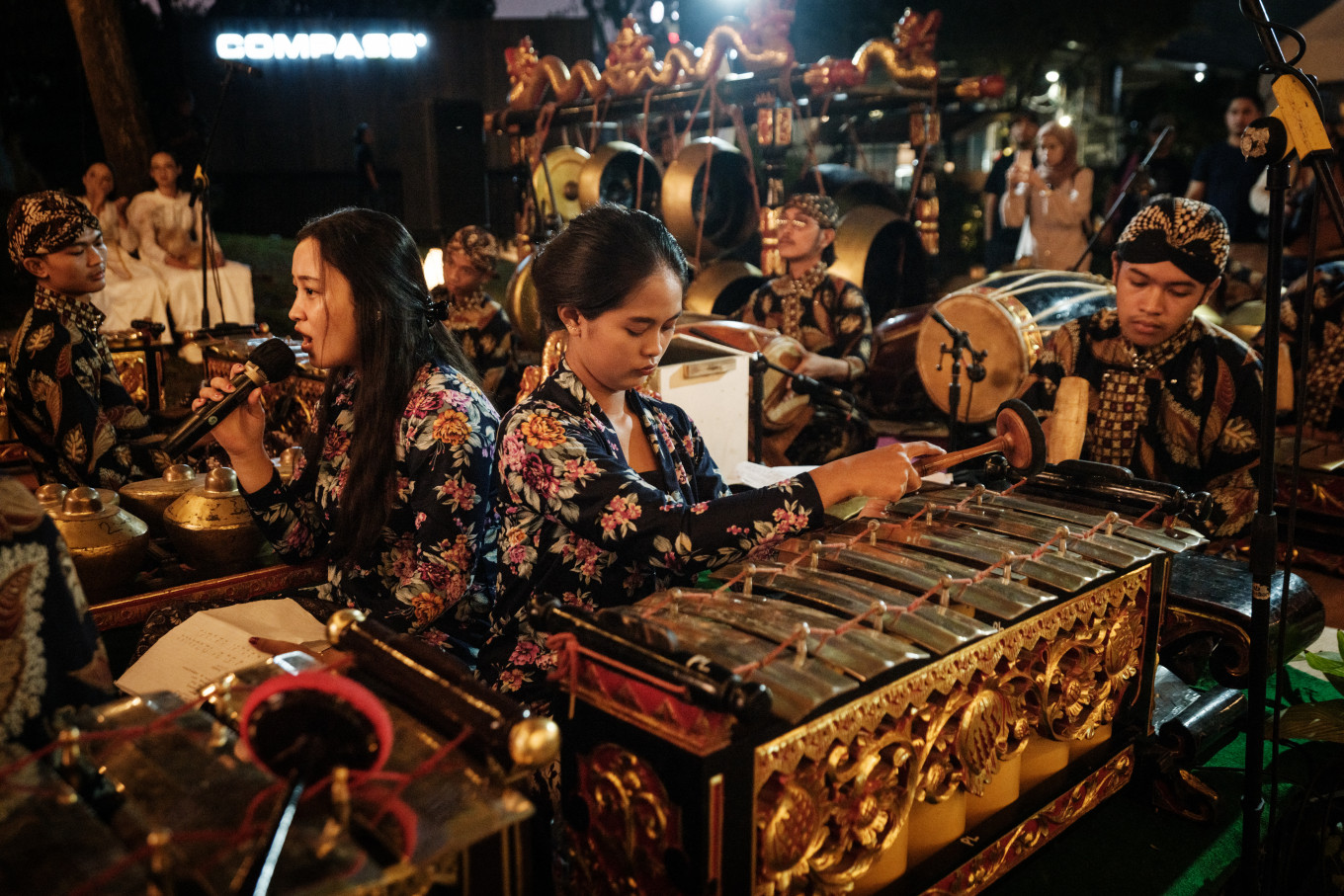
Imagine this: In a pendopo (open-air pavilion) karawitan maestro adjusts the gong instrument and its resonance is a living thread to Java’s past. Meanwhile, outside, his granddaughter scrolls Spotify, her ears filled with the homogenized beats of global pop.
This dissonance is not merely generational but a battle for cultural survival. Indonesia’s musical traditions, forged in bronze gongs and bamboo flutes, are hollowed by “Spotify’s algorithmic empire” and reduced to clickable exotica. At the same time, their guardians starve. Centuries of sonic wisdom risk extinction in the digital age, not through irrelevance but through systemic extraction.
Spotify’s global dominance masks a brutal economy. Artists earn $0.0038 per stream, a model that devastates traditional musicians. A gamelan ensemble requires one million streams to match the earnings of a single live performance.
UNESCO documents how such poverty wages accelerate the closure of village music schools, severing intergenerational knowledge transfer. When a suling (traditional Indonesian flute) virtuoso earns $12 a year from Spotify, barely enough to repair his bamboo flutes, the system isn’t broken; it is engineered to erase.
Algorithms amplify this erasure. Playlists like Lagi Viral (Currently viral) prioritize K-pop-inspired pop, while intricate forms like Tembang Sunda (Sundanese songs) or Balinese Gong Gede languish in obscurity.
When traditional music surfaces, it is stripped of context: Sacred gamelan compositions appear in “Zen Garden” playlists, their spiritual ties to wayang kulit (shadow puppet) rituals reduced to relaxation for foreign ears. Metadata compounds the violence, anonymizing creators under labels like “Music of Indonesia”, a colonial practice that erases individual mastery and regional nuance.
Indonesia’s policy inertia mirrors its colonial past. While the South Korean government put a lot of effort into promoting local heritage on a global scale, Indonesia’s archives decayed. Reel-to-reel tapes of 1970s wayang kulit performances and irreplaceable records of Javanese cosmology molder in storage. The state’s failure to digitize or regulate perpetuates modern plunder: Spotify profits from cultural extraction while communities lose agency over their soundscapes.
The solutions lie in sovereignty and equity. First, Indonesia must legislate some kind of “Cultural Royalty Fund”, redirecting larger amounts of money annually to sustain traditional artists.
Global precedents exist: Norway already made a major effort to preserve Sámi joik; Australia’s First Nations Heritage Grants program revives aboriginal traditions. Indonesia’s fund could subsidize angklung workshops in West Java or tifa drum collectives in Papua, ensuring living traditions thrive beyond algorithmically mediated scraps.
Second, reclaim ownership through digitization. Partnering with institutions to preserve and ethically distribute archival recordings would counter Spotify’s flattening of context. Kacapi and suling tracks could be tagged with their Sundanese origins and ritual significance, and sasando pieces could be linked to Rote Island’s oral histories. Metadata must honor creators, not anonymize them.
Third, disrupt the algorithmic status quo. Canada’s Bill C-11, widely known as “The Online Streaming Act,” compels platforms to disclose how they promote local content; Indonesia could mandate quotas for traditional music in user feeds.
Imagine every 10th recommended track sourced from a national heritage catalog, with gamelan or talempong woven into Gen Z’s daily streams. Algorithms built to create addiction could instead be used for education.
Fourth, nurture local alternatives. Subsidizing platforms like Langit Musik or The Store Front to prioritize traditional with fairer royalties would decentralize power. Japan’s support for conventional Japanese enka music shows how states can incentivize heritage consumption without surrendering to Spotify’s terms.
Finally, reimagine education. Embedding Tembang Jawa or Minang saluang (Minangese flute) into school playlists and liner notes on their cultural roots could reconnect youth to their sonic heritage. This isn’t nostalgia, it is strategic resistance.
Spotify’s founder and CEO Daniel Ek, once argued that “streaming democratizes music“, but democratization for whom? When major labels and big Western pop superstars pocket the immense revenues of royalties, and Spotify takes 30 percent as fees, innovation becomes a rigged game. The beneficiaries are shareholders, not the sape’ players whose arrangements are sampled without credit.
Indonesia’s soundscapes are not raw material for algorithmic commodification. They are living systems of knowledge, binding communities to land, history and identity. A gong is more than a bronze disc, rather, it is a vessel of collective memory. To let it fade into the algorithmic abyss is to surrender sovereignty over culture.
The path forward demands political courage. Lawmakers must regulate platforms, fund digitization and empower communities. Indonesia’s musical soul cannot survive as background noise for Spotify’s playlists. It must be heard, respected and fought for on its own terms.
PS: Previously featured on The Jakarta Post.
 Aris Setyawan
Satu tanggapan untuk “Beyond the Algorithm: Rescuing Indonesia’s Soundscapes from Digital Extinction”