
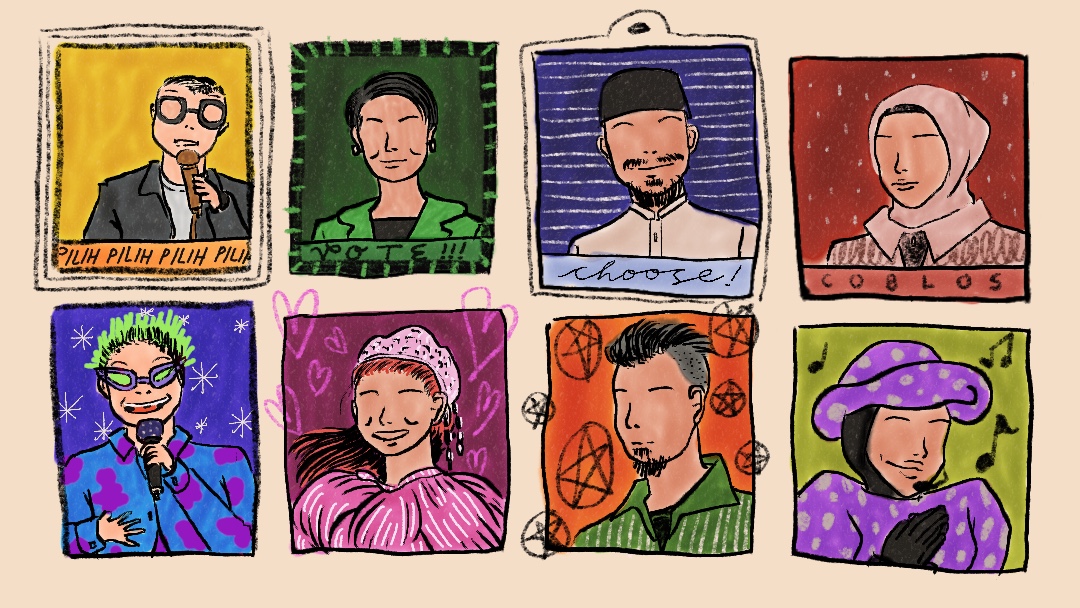
The practice of political parties nominating celebrities for elections thanks to their popularity and perhaps money has become prevalent in Indonesian politics. The celebrities come from various fields ranging from movie and soap opera performers to musicians.
The reason behind their candidacy is simple. These celebrities are famous and the political parties can expect to reap as many votes as possible.
This phenomenon is not a joke. The Big Indonesian Dictionary (KBBI) even includes “political celebrity” in its vocabulary, which means “celebrity who plunges into the political scene”.
There are some musicians and singers who serve as House of Representatives members and many more will follow suit if elected in the Feb. 14, 2024 polls. The question is what is the impact of having them in the House?
This question is crucial because they are the representatives of the people, and they must draft laws to regulate a just social life and protect people’s rights. To be specific, they are supposed to help develop music in the country and fulfill musicians’ rights.
One of the most prominent musicians who turned to politics is Anang Hermansyah who served in 2014-2019 under the banner of the National Mandate Party (PAN). Other musicians are Tere (Democratic Party, 2009-2014 period), Harvey Malaiholo (Indonesian Democratic Party of Struggle [PDI-P], 2019-2014), Mulan Jameela (Gerindra Party, 2019-2024) and Kris Dayanti (PDI-P, 2019-2024).
More musicians are contesting the 2024 legislative elections. Former drummer of legendary underground band and singer Marcell Siahaan (PDI-P), Element band drummer Didi Riyadi (NasDem Party), Ungu band vocalist Sigit Purnomo Syamsuddin Said alias Pasha Ungu (PAN), songwriter Melly Goeslow (Gerindra), Dewa 19 band leader Ahmad Dhani (Gerindra), singer Once Mekel (PDI-P), singer Nafa Urbach (NasDem) and singer Delpi Suhariyanto (Nusantara Awakening Party [PKP]).
Unlike other musicians running for office, Delpi, the vocalist of Dongker, a thriving punk band adored by music lovers, will vie for a seat in the East Java provincial legislative council.
Back to the aforementioned question, do these musicians have the capability and ability to become politicians? Will they impact the development of music in Indonesia?
Reflecting on the past, unfortunately, rather than contributing to the world of Indonesian music, the musicians-cum-politicians have caused problems.
We can recall the music bill, which sparked a controversy in 2018 because it was seen as curbing the creativity of musicians. One of the lawmakers who proposed the bill was Anang.
A group of musicians under the National Coalition Against the Music Bill considered the bill a farce because its articles were open to multiple interpretations. Among them was a provision that prohibited musicians from creating work that promoted negative Western culture, humiliation of human dignity, religious blasphemy and pornography. Another clause required musicians to be certified. The most ridiculous fact of the bill was its theoretical basis, which quoted articles on Blogspot and the writings of a vocational school student.
The House dropped the bill eventually, but the story demonstrates the disappointing performance of musicians who turn to politics.
A pressing issue related to the Indonesian music industry that deserves the attention of legislative candidates is copyright. It has become more urgent now than ever because in this digital age music lovers access more music on internet digital music platforms than through a physical release such as a compact disc, cassette or vinyl record.
The latest research by Koalisi Seni, titled “Secretly Harming: The Situation of Digital Music Copyright in Indonesia”, found that amid the rise in digital music platforms, government policies cannot protect creators and their work. The prevailing legislation, Law No. 28/2014 on copyright, is an insufficient response to the latest developments in the industry.
Furthermore, the study revealed that digitalization has perpetuated the power imbalance between users and technology authorities, musicians and digital music platforms, record labels and intermediary parties.
To deal with the new challenges, the government founded the National Collective Management Institute (LMKN) under the Directorate General of Intellectual Property Rights (HKI) to address the issue of royalties. The LMKN is assigned to collect and distribute royalties to songwriters/musicians in Indonesia, both foreign and domestic songwriters.
In practice, however, there are still many obstacles to the collection and distribution of royalties. Most recently Ahmad Dhani and former Dewa 19 vocalist Once were embroiled in a dispute over copyrights. Dhani prohibited Once from performing Dewa 19 songs because the latter had quit the band.
The Dhani vs Once case sharpened to the point that Kris Dayanti, perhaps one of the highest-paid singers who now serves as a member of House Commission IX overseeing cultural affairs, spoke up. However, she failed to offer a substantial solution.
Musicians who are elected as House members will be responsible for solving the complicated matter of royalties in this digital age. They can demand a transformation of the LMKN into an independent institution with a budget sourced from the state. They can also propose the formation of a song and music information system to protect the creative work and ensure the welfare of songwriters/musicians.
The country’s music industry is also facing the constant threat of piracy, which requires concerted efforts from all stakeholders, including society, to cope with.
Solving the problems plaguing the music industry should be the priority of the musicians who win the legislative elections next February. If we cannot hope that they will bring changes to the industry, why should people vote for them in the first place?
Ps: Previously featured on The Jakarta Post.
Talented artist Deidra Mesayu made a very good illustration for this writing.
 Aris Setyawan